
Junglepixiebelize - Recollections of a Gringa Pioneer
Nancy R Koerner - Copyright@2021 - All Rights Reserved
CHAPTER EIGHT
"Rio Macal"
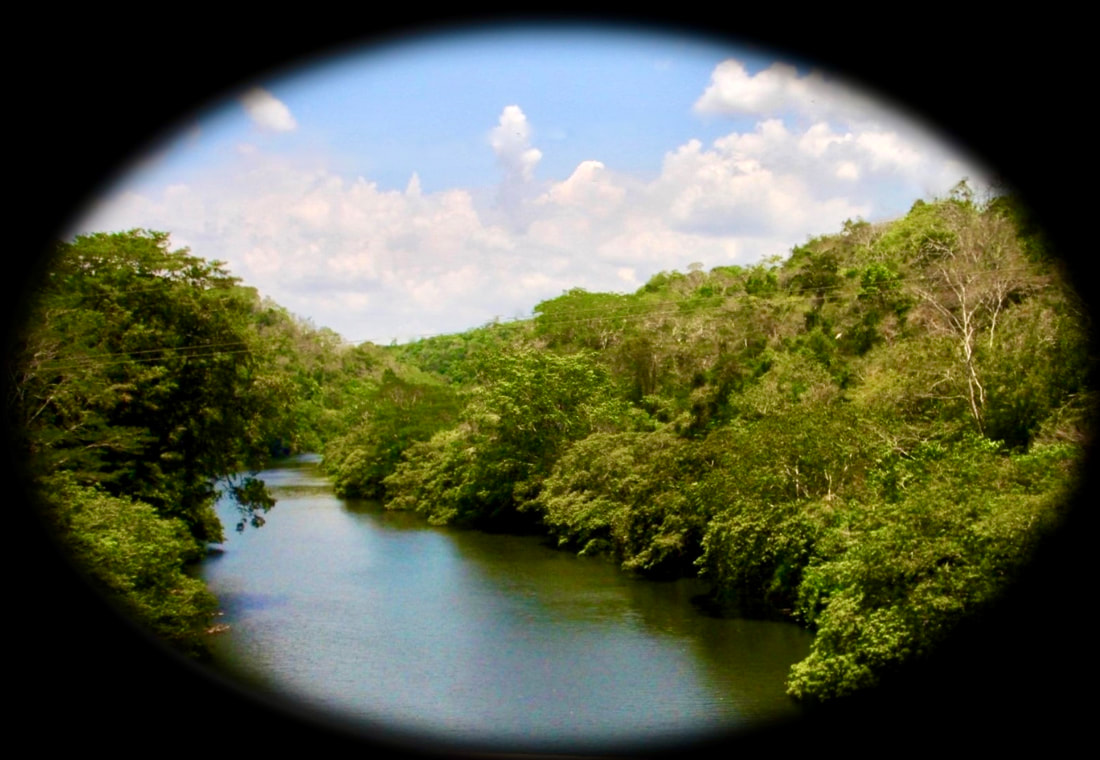
My first view of the Macal River from the Hawkesworth Bridge had taken my breath away It's spirit had called me here. It calls me still.
The vast grassy savannah in the little town of San Ignacio had provided the perfect place to park for the night. However, just after first light, curious brown faces, and pressed noses, had already begun peering into windows of the van from only inches away. Apparently, Cayo had never seen anything like us before. Of course, there was nothing new about Americans coming to visit Belize, but this was different. Our family was at the forefront of a different tribe of gringos, a diaspora of young American families that were not coming simply to visit, but to stay and buy land. We had brought kids, woodworking tools, farming tools, and tiny generators. We were homesteaders.
The vast grassy savannah in the little town of San Ignacio had provided the perfect place to park for the night. However, just after first light, curious brown faces, and pressed noses, had already begun peering into windows of the van from only inches away. Apparently, Cayo had never seen anything like us before. Of course, there was nothing new about Americans coming to visit Belize, but this was different. Our family was at the forefront of a different tribe of gringos, a diaspora of young American families that were not coming simply to visit, but to stay and buy land. We had brought kids, woodworking tools, farming tools, and tiny generators. We were homesteaders.
Down at the riverside, I reveled in the moment, barely able to absorb this new reality. I was now experiencing the exact sense of wonder I had hoped for ever since our arrival in Belize—indeed, had longed for all my life. The sound of an outboard motor suddenly pulled me out of my reverie. A long heavy dugout was approaching from upstream, a slim black man in a cowboy hat at the tiller. After having initially angled towards the western savannah, at the last moment he had briefly swerved to starboard, and then taken a hard left-to-port. With great finesse, he used the river’s current to swing the entire boat a hundred-and-eighty degrees, so the craft ended up with the bow pointing upstream, the length of the dory perfectly parallel to the bank; the man was an artist. The single passenger, a tiny, birdlike, old white woman, stepped off the boat. With a faint Swiss accent, Mrs. Blackmore introduced herself, while the dory man tilted the small outboard motor forward, locked it into position, and secured the craft. He touched the brim of his hat respectfully, and then cracked a brilliant white smile. This was Mr. “Dicky” Simpson, dory man.
Mrs. Blackmore owned a large expanse of property several miles upstream. She had come to town for Saturday morning market-day, and now, like an ebullient mother hen, took me under her wing, personally showing me where to make my purchases. Truthfully, when it came to the fresh fruits and vegetables, I didn’t exactly see where the “market” was. In contrast to the gigantic marketplace that would, decades later, sprawl across the entire Cayo savannah, it now consisted of only four or five Belizean women standing outside in the shade of Kalim Habet’s store selling vegetables straight out of buckets, and a single pair of Mennonites in a horse-drawn wagon selling carton-flats of brown eggs out of the back. Nevertheless, this first modest tour of tiny "San Ig" and its vendors would serve me well—the introduction to my new hometown.
The far greater impact was the fact that Mrs. Blackmore’s oldest son, Marsh Blackmore, had recently moved to the States, leaving behind his empty house, about a half-mile from her own. It was available for rent, and yes, it was right on the river. By early afternoon, we were all headed upstream, with Don Dicky at the helm.
“Don Dicky? Excuse me. May I ask a question?” I pointed. “I see a huge log, way up there, lodged in the fork of that enormous tree. Did someone hoist it up there for a reason?”
"Well, no, Miss Nancy. Yu see, de flod lef it. Ah seen dis riba rayz bowt siksti-fut inna de tap-gyalan flod. Wai yu tink de hows bilt so hai-op, weh fahn de waata?"*
At the time, I couldn’t even answer. I could not comprehend, in my wildest imagination, any flood that could rise to that height. Yet, not long afterwards, I would see that very phenomenon happen with my own eyes. In fact, I would see the river go even higher—and more than once.

The Macal River...be still, my heart. I am still there. Every new bend brought the realization of another dreamscape fantasy. The coursing waterway flowed past sheer rock walls, the shade of high tropical forest, thickets of bush-bamboo, and alongside green pasturelands. Massive boulders, the size of two-story houses, rose from the depths of clear glassy pools, their upper reaches smoothed by millions of years of antediluvian floods. Occasionally, a lone ceiba tree towered above the canopy like a royal monarch observing its realm.
|
Enormous male gray-green iguanas, four feet in length, with long black and orange tails, sunned themselves lazily on branches overhanging the river, plopping into the water if the dory came too near.
An occasional thatched house, surrounded by coconut palms and citrus trees, came into view from time to time, and Brahma cattle stood contentedly in pastures, as white egrets feasted on fat purple ticks embedded in their humps. A haven for birds, crested blue kingfishers skimmed over the water, barely an inch above the surface. I heard a raucous bird, calling out the sound, “chachalaca, chachalaca,” only to find out from Don Dicky, that was its local name. There were flycatchers, warblers, tanagers, doves, orioles, and curious-looking woodrails, low-running in the bush on gaudy orange feet. The unpainted rectangular wooden house was about eighty feet above the river’s level, at least that day. It was easy to recognize the two distinct benched-out flood-plains in between, and vital to know the extremes to which the river
|


|
could rise. Like many houses, the second-story structure was raised on enormous twelve-by-twelve hardwood posts, solidly rooted into bedrock. The house was unfurnished except for a small butane stove and kerosene fridge in the kitchen. The living room was empty, as was the only bedroom. Although plain and unsophisticated, the entire house was well-built, made of solid Honduran mahogany.
We stood there on the property, and stared at the house. It was all we needed, and everything we could have hoped for. Nobody spoke. Then Mrs. Blackmore said she’d rent Marsh's house to us for $70 BH* per month. Without even exchanging a glance of quick consultation, we said in unison, "We'll take it."
***************************
*$35 dollars U.S.
*$35 dollars U.S.